EcoFlow DELTA 2 Review UK: Is It Worth It for Plug-in Solar?
The most popular portable power station for pairing with plug-in solar in Germany. Here's whether the DELTA 2 makes financial sense for UK owners.
The EcoFlow DELTA 2 is the battery that keeps appearing in plug-in solar conversations. German Balkonkraftwerk owners adopted it as the go-to companion for balcony solar, and it's the most commonly recommended portable power station for the UK's emerging plug-in solar market.
At around £599, it's a significant investment on top of a £500-700 solar kit. The question is whether the added value justifies the cost — and the answer depends entirely on your consumption pattern.
What You Get
The DELTA 2 is a 1,024Wh lithium iron phosphate (LFP) battery with a 1,800W AC output (surge to 2,700W). In practical terms: it stores enough electricity to run a fridge, lights, laptop, and TV for 3-4 hours, or to power a single large appliance (kettle, microwave, hairdryer) for brief periods.
Key specs:
- Usable capacity: ~1,024Wh (LFP chemistry, so very close to rated)
- AC output: 1,800W continuous, 2,700W surge
- Solar input: 500W max (MPPT built in)
- Charge from wall: 0-80% in 50 minutes (fast AC charging)
- Weight: 12kg
- Cycles: 3,000+ to 80% capacity (LFP chemistry advantage)
- Warranty: 5 years
The LFP chemistry is the headline here. Earlier lithium-ion batteries degraded to 80% capacity within 500-800 cycles. LFP achieves 3,000+ cycles to 80%, which at one full cycle per day translates to over 8 years of useful life.
How It Works with Plug-in Solar
The simplest setup: your plug-in solar panels generate electricity during the day via a micro-inverter. The micro-inverter feeds AC electricity into your ring main. Anything your home doesn't consume at that moment is exported to the grid (typically unpaid).
Adding a DELTA 2 gives you a way to capture that surplus. You can either:
Direct solar charging — connect the panels directly to the DELTA 2's solar input via MC4 cables, bypassing the micro-inverter entirely. The DELTA 2's built-in MPPT controller optimises the charge. You then use the stored electricity in the evening via the DELTA 2's AC outlets. This is the simplest approach but means the panels aren't feeding your ring main during the day.
AC pass-through — feed the micro-inverter output into the DELTA 2's AC input, charging it from your ring main (which is being fed by solar). This is more elegant because the DELTA 2 acts as a buffer: it charges when solar exceeds consumption and supplies power when it doesn't.
EcoFlow's own app lets you set charging schedules, output limits, and monitoring — all useful for optimising the solar-to-battery flow.
- 800W dual-panel kit with 1kWh Delta battery
- Store daytime solar for evening use
- Full home backup mode
- Smart scheduling via EcoFlow app
The Financial Case
The maths is straightforward but context-dependent.
Without a battery: An 800W plug-in solar system in the UK generates roughly 600-700 kWh per year. If you self-consume 50% (typical for a household out during the day), you use 300-350 kWh and export 300-350 kWh unpaid. At 24p/kWh, you save roughly £72-84 per year.
With a DELTA 2: The battery captures some of that exported surplus and shifts it to evening use. If it captures an additional 1 kWh per day for 200 sunny days, that's 200 kWh per year shifted from export to self-consumption. At 24p/kWh, the battery adds roughly £48 per year in savings.
Payback on the battery alone: £599 ÷ £48/year = approximately 12.5 years on a flat-rate tariff.
On a time-of-use tariff: If your daytime rate is 30p and overnight is 8p, you can also charge the battery overnight at 8p and use it during the day when solar isn't generating enough. The arbitrage alone (22p spread × 1kWh × 365 days) adds roughly £80/year. Combined with solar self-consumption uplift, payback drops to roughly 5-6 years.
With Octopus Flux: Flux pays for exports and charges cheaply for overnight import, maximising the battery's value. On Flux, payback could be 4-5 years.
Build Quality and Day-to-Day Use
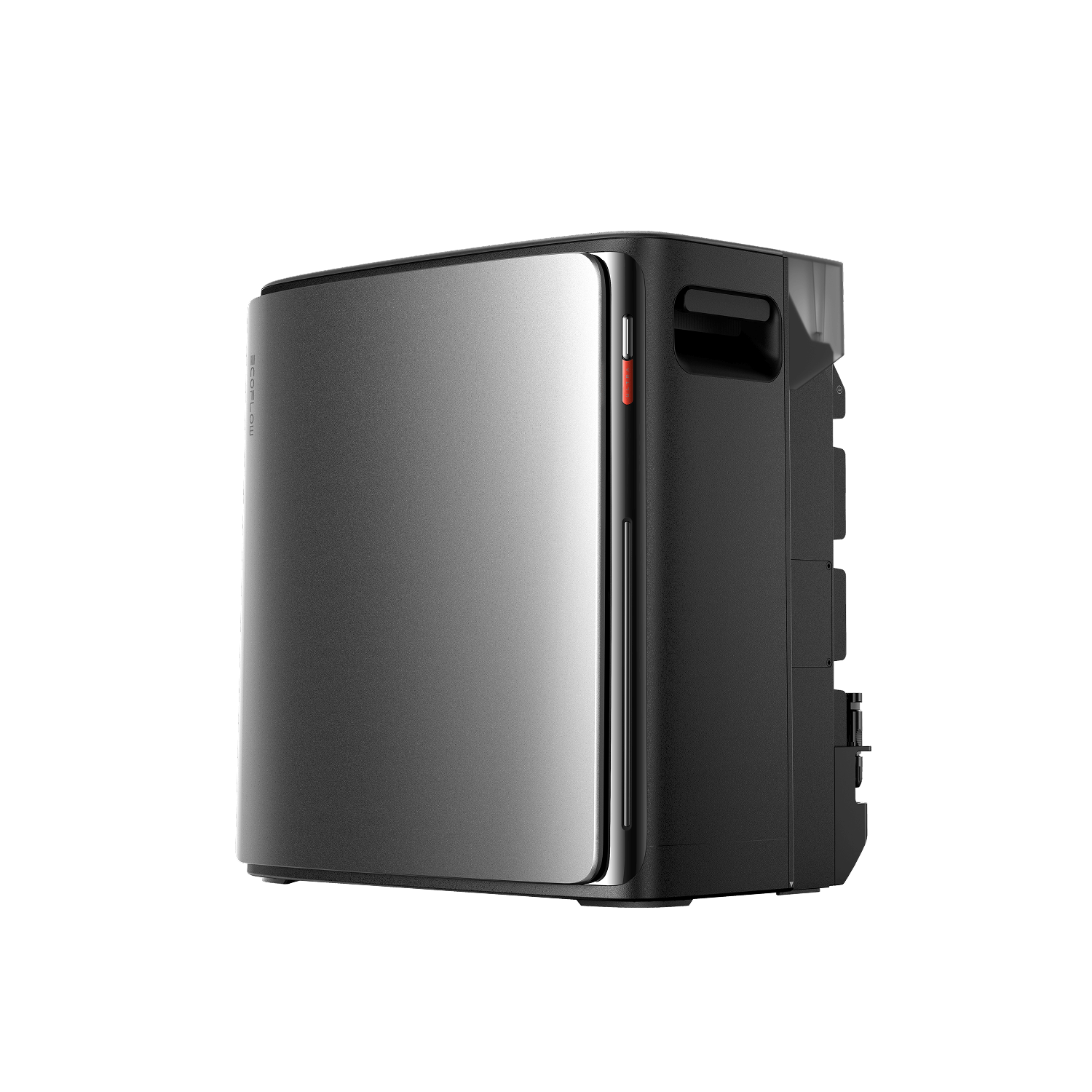
The DELTA 2 is solidly built — a rectangular metal and plastic unit about the size of a small microwave. The display shows input/output wattage, battery percentage, and estimated time to full/empty. Two UK 3-pin AC outlets on the front, USB-A and USB-C ports, and the solar/car charging inputs on the side.
It's quiet during normal operation. The fan runs during fast AC charging (noticeable in a quiet room but not loud) and is silent during discharge at low loads.
The EcoFlow app gives remote monitoring and control, including charge scheduling and output limits. It's one of the better battery management apps on the market — significantly more intuitive than many competitors.
Versus the Competition
Anker SOLIX C1000 Gen 2 — slightly more usable capacity (1,056Wh), similar LFP chemistry and cycle life. Slightly more expensive at around £799 but newer design. If budget isn't the primary concern, the C1000 is worth considering for its marginally better specs and newer app platform. See our battery comparison guide for the full head-to-head.
Jackery Explorer 1000 v2 — a more portable option at slightly lower capacity. Better suited to camping and outdoor use than home solar storage. If portability matters (caravan, motorhome), the Jackery is the right choice. For a fixed home installation, the DELTA 2 or SOLIX C1000 offer better value.
Who Should Buy One
Yes, if: you're out during the day and monitoring shows you're exporting 50%+ of your solar generation. The DELTA 2 captures that lost value. Also strong if you have or plan to move to a time-of-use tariff where the overnight/daytime price spread makes arbitrage worthwhile.
Maybe, if: you're home during the day and self-consuming most of your generation. The battery adds marginal value here — it's mainly useful for cloudy-day buffering and overnight use of surplus.
Not yet, if: you don't have plug-in solar installed yet. Buy the panels first, monitor your generation and self-consumption for a season with a Tapo P110, and then decide whether battery storage fills a real gap in your setup.
The Verdict
The DELTA 2 is the battery to beat for UK plug-in solar owners. The LFP chemistry, 3,000+ cycle life, solid app, and reasonable price make it the easiest recommendation in its category. The financial case is strongest on time-of-use tariffs and for households with significant daytime exports. On a flat-rate tariff for a stay-at-home household, the payback stretches beyond what most people would consider worthwhile.
Buy the EcoFlow DELTA 2 on EcoFlow.
For the full battery comparison, see our EcoFlow vs Anker SOLIX vs Jackery guide. For tariff optimisation with battery storage, see our best energy tariff guide.
Related reading
See how much plug-in solar could save you — with real data for your postcode.