Flat Roof Solar UK: Ballast Mounting
Flat roof plug-in solar UK guide. Ballast-mounted panels on extensions and garages — no drilling, no mess, just generation.
Why Flat Roofs Are Perfect for Plug-in Solar
The UK has millions of flat-roof extensions, garage roofs, and kitchen extensions. Most of them see nothing but rain and pigeons. Ballast-mounted plug-in solar changes that.
Here's why flat roofs and plug-in solar are a perfect match.
No drilling. Ballast frames use weight, not fasteners. You're not penetrating the roof membrane, which means you're not creating a potential leak point.
No structural work. You're not asking the roof to support permanent fixings. The frames sit on the surface like a heavy planter box.
Reversible. If you ever want to remove the solar, you lift the frames off. The roof is exactly as it was before.
Optimal angle. Frames are adjustable, so you can tilt panels to the ideal 25–35° for UK generation without any custom fabrication.
Maintenance-friendly. You can walk around the frames, inspect drainage, clean panels if needed. Everything is accessible.
It's the honest reason why ballast mounting was invented: for situations exactly like this.
Pre-Installation: What You Need to Check
Before you order panels and frames, do this homework.
Roof Condition
Walk around your roof (safely, from a ladder, or use binoculars from the ground). Look for:
Obvious damage: Tears, blisters, or areas where the membrane is visibly worn. If the roof is at the end of its life, solar won't extend it. You might be better off replacing the roof and then adding solar. If damage is localized, it can be repaired before solar goes on.
Pooling water: Some flat roofs pond slightly in corners. This is usually fine, but if water sits for days after rain, drainage isn't great. Ballast frames are designed with gaps underneath to allow water to flow, but if the roof is genuinely poorly drained, address that first. A slight slope is normal and fine.
Surface type: EPDM (rubber), GRP (fiberglass), or felt are all ballast-mounting friendly. Asphalt shingles or lead are less ideal (they're brittle or deform under load). If you're unsure, take a photo and ask the installer.
Load Capacity
Ballast frames weigh 10–15kg each. The solar panels themselves are 20–25kg each. A 400W array (two panels + two frames) adds roughly 70–90kg total, or 25–30kg/m² spread across the roof surface.
Most modern flat roofs are designed for residential loading (people working on them, maintenance, snow) of 150–200kg/m². An additional 25–30kg/m² is well within tolerance.
If your roof is old or you're unsure: Have a surveyor spend 30 minutes checking. They'll look at the roof structure, check documentation, and confirm load capacity. Cost: £150–£300. It's a good insurance policy.
If your roof is brand new (post-2010): It's almost certainly fine.
If you're on a listed building or conservation area: Check with your local authority or conservation officer. They might have requirements about aesthetics or materials. (Solar on flat roofs is usually acceptable; check first.)
Drainage
Look at your gutters and downpipes. Are they clear? Does water drain quickly after rain? This matters because ballast frames have gaps underneath, and water will flow around them. If the roof drains well already, solar won't change that. If drainage is poor, add a bit more love to gutters and downpipes before mounting the solar.
Structural Penetrations
Walk your roof and note where utilities or services are located: vent pipes, flashing, pipes running up walls, roof lights, antennas. You'll want to avoid placing ballast frames directly above these or in awkward angles. Plan your layout before ordering.
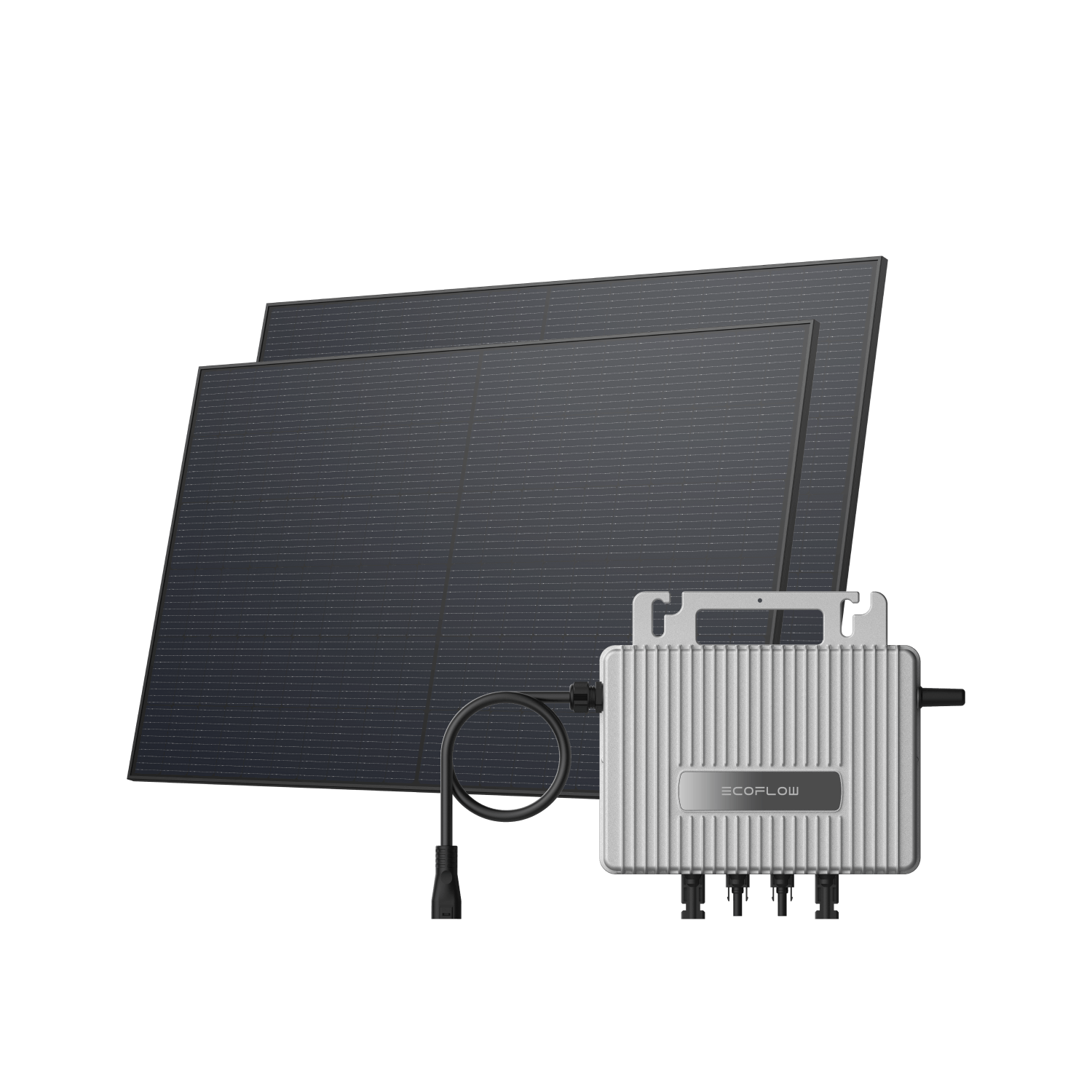
- 800W dual-panel balcony or garden kit
- 600Wh plug-in battery included
- App with live monitoring & smart scheduling
- Balcony, garden & flat-roof mount options
Ballast Frame Systems: What's Available
A ballast frame is essentially a weighted stand that holds one or two solar panels at an adjustable angle.
Standard configurations:
Two-panel portrait frame: Holds two panels mounted vertically (portrait orientation). Typical size: 2 metres wide, 1 metre tall, weighing 15–20kg. Cost: £200–£350.
Two-panel landscape frame: Holds two panels horizontally (landscape). Slightly wider footprint, often lower profile. Cost: similar.
Single-panel frame: For a single smaller panel. Cost: £100–£150. The Renogy Adjustable Tilt Mount is a popular choice for single panels, offering adjustable angles.
Angle adjustment: Most frames let you set tilt from 10° to 35°. Some are fixed-angle (you choose one and it's locked). Adjustable is better because you can optimize for seasonal performance later.
Materials: Aluminium (lighter, easier to handle) or galvanized steel (heavier but very durable). Both work fine.
Common manufacturers: Esdec (Dutch, widely available in the UK), Mounting Systems, Solarmax, and others. Your panel supplier will often bundle compatible frames.
The Installation Process
Layout and Positioning
Measure your roof. Identify the south-facing area (or south-southeast/southwest). That's where you want the panels.
Account for shade. If a chimney, roof light, or building edge casts shadow, avoid that spot.
Leave clearance from the roof edge (at least 1–2 metres) to avoid wind-loading edge effects. Also, you want to be able to walk around the frames for maintenance and cleaning.
Sketch the layout. For a 400W array (two panels), you need roughly 2 metres by 1.5 metres of space.
Preparing the Roof
Sweep and clean the surface where the frames will sit. Remove debris, leaves, moss. You don't need to power-wash (which can damage the roof membrane), but a broom and mild water spray are fine.
Check drainage one more time. Frames shouldn't sit in water; they should sit on a surface where water can flow underneath and around them.
Placing Frames and Panels
This is straightforward.
- Carefully carry the ballast frame (they're heavy but manageable) up to the roof.
- Position it in the marked spot.
- Ensure it's level (use a spirit level). Some settlement of the frame under its own weight is normal.
- Slot the solar panels into the frame's fixtures (frames have grooves or clips designed for this).
- Tighten any panel clips or fasteners per the manufacturer's instructions.
- Check that panels are secure and won't shift in wind.
Repeat for additional frames if you're installing more than one.
Cabling
Run heavy-gauge DC cables from the panels to the inverter. For a typical installation:
- Cables from panels to a combiner box (if you have multiple strings) or directly to the inverter: 6–10mm² cable (depends on current).
- Cables should be routed away from high-traffic areas on the roof, secured with clips every metre or so.
- Route cables through a wall conduit into the building, ideally down an exterior wall or through an existing gap.
Important: DC cables are a shock hazard. If you're not confident, hire a sparky. Cost: £300–£600 for a day to run cabling and install the inverter.
Inverter Installation
The inverter usually lives indoors: in a utility room, garage, or cupboard. It needs:
- Access to a socket (or a dedicated circuit if you've had one installed)
- Ventilation (somewhere it can breathe; avoid enclosed cupboards)
- Protection from temperature extremes (not a freezing garage or a boiling attic)
AC cables run from the inverter to your chosen socket or circuit. The inverter also needs a DC disconnect switch (between it and the panels) and an AC circuit breaker (between it and the socket/circuit). Most modern inverters have these built-in or included.
Testing
With everything connected, use a multimeter to check:
- DC voltage from the panels (on a sunny day, should be in the expected range, typically 200–400V depending on the inverter)
- AC output from the inverter (should be 230V nominal UK voltage)
Switch the inverter on. On a sunny day, it should be generating and showing on its display. Check the consumption in your home: when panels are generating, your meter should be running slower (or backwards if you have smart metering).
A Worked Example: A Typical Installation
You have a 4-by-6-metre flat garage roof. It's EPDM, in good condition, well-drained. You want 400W of solar (two 200W panels) mounted at a 30° angle facing due south.
Step 1 – Preparation (1 hour)
- Check roof condition: tick
- Check load: a surveyor or your installer confirms capacity: tick
- Clean roof surface: done
Step 2 – Frame and Panel Installation (2 hours)
- Carry two ballast frames up (with a helper, they weigh 15kg each): done
- Position them 2 metres from the roof edge, aligned south-to-north, 1 metre apart
- Set angle to 30° (adjustable on the frame): done
- Slot two 200W panels into the frames: done
- Tighten clips: done
Step 3 – Cabling (2–3 hours, or 4–5 hours if a sparky is doing it)
- Run DC cables from panels to the inverter (through a wall conduit or down the exterior): done
- Install inverter in a utility cupboard or garage: done
- Run AC cables to a nearby socket: done
- Install DC and AC switches and breakers: done
Step 4 – Testing and Sign-Off (1 hour)
- Test DC and AC voltages: done
- Switch on inverter: generating
- Document everything (photos, inverter serial number, meter readings): done
Total time for a confident DIYer: 8–10 hours over a weekend.
Total time if hiring a sparky: One full day (6–8 hours) plus your prep work.
Total cost:
- Panels (two 200W): £250–£350
- Ballast frames: £200–£350
- Inverter (600W): £350–£450
- Cabling, breakers, switches: £100–£150
- Labour (if hired): £500–£800
All-in (DIY): £900–£1,300 All-in (with sparky): £1,400–£2,100
For reference, packaged kits (EcoFlow STREAM, Anker SOLIX) cost £900–£950 and include everything except labour.
Maintenance and Longevity
After installation, there's very little to do.
Cleaning: In dusty areas, panels accumulate dust. A once-yearly rinse with a hose is plenty (no pressure wash, just gentle water). Clean panels generate 2–3% more than dusty ones, but rain does most of the job for you.
Inspection: Walk your roof annually (or every other year). Check that frames are level, panels are secure, cables aren't damaged, and nothing is blocking drainage.
Panel lifespan: Modern panels degrade very slowly (0.5–0.8% per year). A panel rated at 400W will still be 380W+ after 20 years. Essentially, they work for 25–30 years.
Inverter lifespan: 10–15 years. When it fails, you'll replace it (cost: £300–£500). The panels will keep working.
Frame lifespan: Indefinite. Aluminum and galvanized steel don't degrade in the way electronics do.
Common Questions
Q: Will ballast frames blow away in high wind?
A: Modern ballast frames are engineered for UK wind speeds. A 15–20kg frame holding two panels is stable in winds up to 45+ mph. Extremely rare events (storms exceeding this) are statistically unlikely. If you're in an exposed location (Scottish highlands, coastal areas with regular gales), consult the frame manufacturer's wind rating.
Q: Can I walk on the roof after solar is installed?
A: Yes, but carefully. Avoid stepping on cables or placing weight directly on panel corners. The frames are fixed and won't shift under foot traffic.
Q: What if I want to clean gutters or do roof maintenance?
A: You'll work around the frames. They're movable (not permanently fixed), so in a true emergency, you can carefully lift and shift a frame temporarily. In practice, maintenance happens 2–3 times per decade; you'll plan around the solar.
Q: Is there a planning permission issue?
A: Not usually. Domestic solar installations are permitted development in most cases (Class A, part 40 of Schedule 2 to the GPDO 2015). If you're in a conservation area, listed building, or AONB, check with your local planning authority—but solar on flat roofs is increasingly accepted.
Q: Do I need to notify my energy supplier or the DNO?
A: Yes, informally. Send a letter to your DNO (you can find them via your postcode at www.dnos.co.uk) saying you're installing an embedded generator. They log it but don't object. No fee. This is best practice and protects you if there's ever a grid issue.
Next Steps
If you've got a flat roof and you're ready to move forward:
- Inspect your roof and confirm condition and drainage.
- Use the calculator to estimate generation and savings for your postcode.
- Get a quote. Contact a couple of solar installers and ask for flat-roof ballast-mounted kits or DIY bundles.
- Decide DIY vs professional. If you're comfortable with basic electrical work, DIY is feasible. If not, hire a sparky for the cabling and inverter work.
- Install and enjoy. Once it's on, monitor generation occasionally and sleep knowing your roof is working for you.
Flat-roof solar is one of the most straightforward renewable energy projects a homeowner can do. It's satisfying, practical, and it works.
Related reading
See how much plug-in solar could save you — with real data for your postcode.